 how-to
How to Winterize a Jet Ski: Complete Guide
Table of Contents
- Why Winterizing Your Jet Ski Matters
- Prepare Your Personal Watercraft Before Storage
- Flush and Protect Your Cooling System
- Using Jet Ski Fuel Stabilizer and Fuel Tank Protection
- Engine Protection: Fogging Oil and Spark Plugs
- Jet Ski Battery Winter Storage and Antifreeze Winterization
- Your Jet Ski Winterization Checklist
- Common Winterization Mistakes to Avoid
- Frequently Asked Questions
Last Updated: October 19, 2026
Why Winterizing Your Jet Ski Matters
Learning how to winterize a jet ski protects a major investment from cold-weather damage. Water left in the engine, cooling system, and fuel lines freezes and expands, breaking internal parts. Corrosion sets in and fuel breaks down. By spring, your personal watercraft won't start or needs expensive repairs.
Proper winterization takes a few hours now. It saves you thousands later.
At Flemington Powersports, we help customers prepare their personal watercraft for winter storage every season. Understanding how to winterize a jet ski is straightforward: flush the cooling system, protect the fuel, fog the engine, and store it right. We'll walk you through each step.
Prepare Your Personal Watercraft Before Storage
Before the technical winterization steps, gather supplies and do a basic inspection.
What you'll need:
- Fresh water (for flushing)
- Fuel stabilizer
- Fogging oil
- New spark plugs (optional but recommended)
- Engine oil (check your owner's manual for the type)
- Antifreeze winterization fluid (for raw-water systems)
- Soft brush and clean rags
- Basic tools (socket set, wrench)
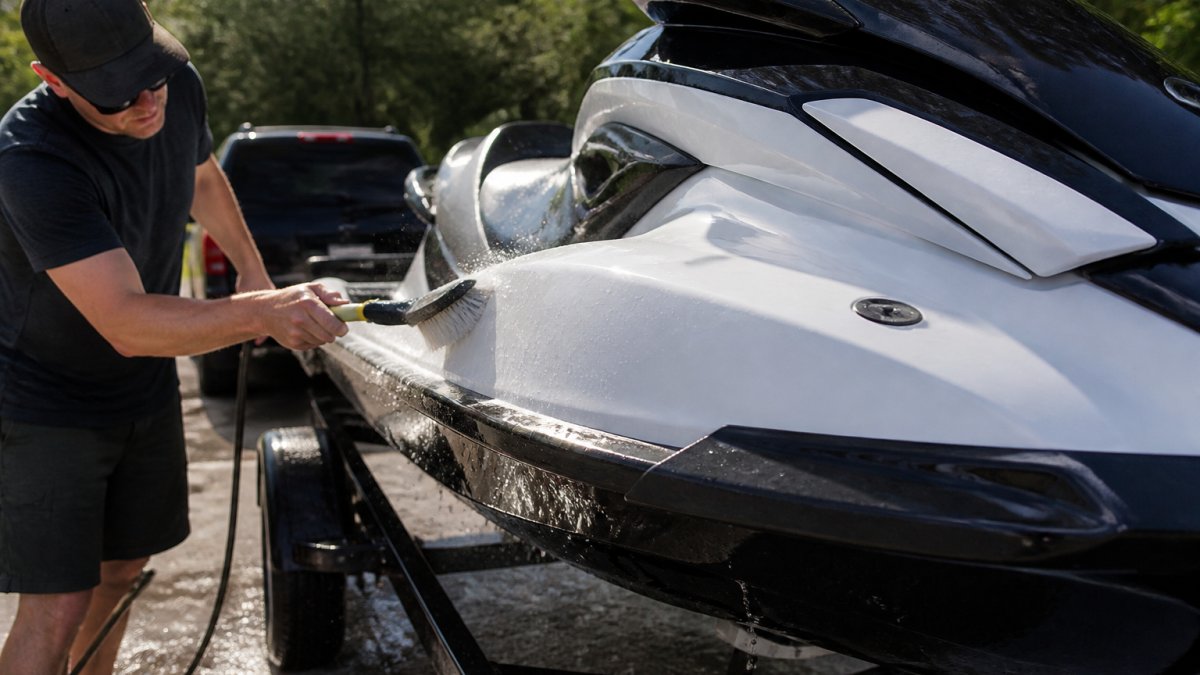
Start by cleaning the hull and exterior. Use a soft brush and fresh water. Remove salt, dirt, and debris. Dry everything with clean rags. Inspect the hull for cracks or damage. Check hoses and clamps for leaks or corrosion.
If you've been running ethanol fuel, drain it and replace it with non-ethanol fuel before storage. Ethanol absorbs water and breaks down over time; non-ethanol fuel stays stable for months.
Flush and Protect Your Cooling System
The cooling system is where most winterization damage happens, and where generic instructions fail. Your jet ski uses either a raw-water cooling system (pulls water from the lake or ocean) or a closed-loop system with antifreeze. Flush and drain steps differ by make, model, year, and cooling design, so read your owner's manual first.
For raw-water systems:
- Start the engine and let it warm up for 2-3 minutes
- Attach a fresh-water hose to the flush port (check your owner's manual for location)
- Turn on the water and run the engine for 5-10 minutes
- Let fresh water circulate through the entire cooling system
- Shut off the engine and disconnect the hose
This flushes out salt, sand, and mineral deposits. Skip it and salt crystallizes inside the cooling passages, blocking water flow. Salt-water riders need a longer flush than freshwater riders, and some manuals specify a minimum flush time by model.
For closed-loop systems with antifreeze:
Check the antifreeze level and top it off if needed. Run the engine briefly to circulate it; you don't need to drain and refill. Confirm the antifreeze type in the owner's manual, since mixing incompatible types can gel the system.
Verify the water is actually out. After flushing, leave the drain plugs open and tilt the jet ski on its side or back so trapped water drains completely.
When antifreeze is appropriate. Antifreeze winterization fluid is not a substitute for draining. It is an extra layer for raw-water systems in climates where temperatures stay below freezing for months, and only after the system is drained.
Using Jet Ski Fuel Stabilizer and Fuel Tank Protection
Fuel degrades over winter. Ethanol fuel absorbs moisture and turns into varnish; non-ethanol fuel lasts longer but still oxidizes. Fuel stabilizer slows this dramatically.
How to use fuel stabilizer:
- Fill your fuel tank with fresh, non-ethanol fuel
- Add fuel stabilizer according to the bottle's instructions (usually one ounce per five gallons)
- Run the engine for 10-15 minutes to circulate the stabilized fuel through the fuel lines and injectors
- Shut off the engine and let it cool
The stabilizer coats the inside of your fuel tank and lines, preventing oxidation and keeping fuel fresh for 6-12 months.
If your jet ski has a carburetor (older two-stroke models), you have two options: drain the fuel tank completely and run the carburetor dry, or add stabilizer and run the engine as described above. Draining is safer for long storage because no fuel means no varnish buildup.
For fuel-injected engines (most modern four-stroke models), always use stabilizer and circulate it. Fuel injectors need fuel to stay lubricated.
Engine Protection: Fogging Oil and Spark Plugs
Fogging oil coats the inside of your engine cylinders, protecting metal surfaces from rust and corrosion during months of inactivity.
How to apply fogging oil:
- Remove the spark plugs (you'll need a spark plug socket)
- Spray fogging oil into each cylinder opening, about one second per cylinder
- Rotate the engine manually a few times to distribute the oil
- Reinstall the spark plugs or leave them out if you're replacing them
This creates a protective barrier inside your engine that burns off harmlessly when you start it in spring.
Spark plug replacement:
Check your owner's manual for the correct spark plug type. If your plugs are more than two years old, replace them now. New plugs start easier in spring and run cleaner. You'll need a spark plug socket, a ratchet, and a gap tool.
If you're keeping the old plugs, clean them with a wire brush and check the gap (the space between the electrodes). Adjust if needed using a gap tool.
Jet Ski Battery Winter Storage and Antifreeze Winterization
Your battery loses charge in cold weather. A dead battery won't turn the engine over in spring. Disconnect the battery and store it in a warm, dry place.
Battery care:
- Disconnect the negative terminal first, then the positive terminal
- Clean corrosion off the terminals with a wire brush
- Store the battery indoors at room temperature
- Charge it every 30 days during winter storage
A trickle charger (battery maintainer) keeps the charge steady without overcharging. Two common options: remove the battery and keep it indoors on a maintainer, or leave it in the craft and connect a maintainer if the storage location has power and stays above freezing.
Spring recommissioning for the battery. Before the first ride, charge the battery fully, check the terminals for corrosion, and reinstall it positive terminal first, then negative. If the battery is more than three or four seasons old and does not hold a charge, replace it rather than risk a no-start on the water.
Antifreeze winterization for raw-water systems:
Some owners add antifreeze winterization fluid to the cooling system as extra protection in cold climates. This differs from the antifreeze in closed-loop systems and comes after the drain and verification steps, not instead of them.
- Run the engine briefly to warm it up
- Locate the raw-water intake and cooling system drain plugs
- Attach a hose to the intake and place the other end in a bucket of antifreeze winterization fluid
- Start the engine and let it pull the fluid through the system for 2-3 minutes
- Shut off the engine
The antifreeze fluid coats all internal cooling passages. In climates where temperatures drop below freezing for months, this extra step prevents ice from forming inside the cooling system. Confirm the fluid type in your owner's manual; some fluids are unsuitable for marine engines.
Your Jet Ski Winterization Checklist
Use this checklist to track your winterization progress. Print it or save it to your phone.
| Task | Completed | Notes |
|---|---|---|
| Clean and inspect hull | [ ] | Check for cracks or damage |
| Flush cooling system with fresh water | [ ] | 5-10 minutes minimum |
| Drain all water from cooling lines | [ ] | Tilt and let sit overnight |
| Replace fuel with non-ethanol fuel | [ ] | Top off tank |
| Add fuel stabilizer | [ ] | Run engine 10-15 minutes |
| Apply fogging oil to cylinders | [ ] | One second per cylinder |
| Remove and inspect spark plugs | [ ] | Replace if over 2 years old |
| Disconnect and store battery | [ ] | Charge every 30 days |
| Add antifreeze winterization fluid | [ ] | For raw-water systems only |
| Cover and store jet ski | [ ] | Use breathable cover |
Print this and check off each step as you go so you don't forget critical steps.
Common Winterization Mistakes to Avoid
Skipping the cooling system flush is the biggest mistake. Owners think it's optional. Salt and minerals stay inside. By spring, the water pump fails or cooling passages clog. The repair costs $500-$1,500.
Don't store your jet ski with a full tank of ethanol fuel. The fuel breaks down and leaves varnish. Your fuel injectors clog. The engine won't start or runs rough.
Never skip fogging oil. Metal inside your engine corrodes without protection. Rust builds up on cylinder walls. Your engine seizes when you try to start it in spring.
Leaving the battery connected drains it completely over winter. A dead battery won't turn the engine over. You'll need a jump or a new battery.
Storing your jet ski outside without a cover invites problems. UV light degrades the hull. Rain and snow collect inside. Leaves and debris clog intake ports.
Don't use the wrong antifreeze winterization fluid. Some fluids are toxic to marine engines. Check your owner's manual and buy the correct type.
Winterizing your jet ski takes a few hours in the fall and saves thousands in spring repairs while keeping your personal watercraft running reliably for years.
If you're not sure about any step or need help with your specific model, visit Flemington Powersports or call us at 908-237-0099.
Frequently Asked Questions
Do you need to winterize a jet ski?
Yes. Winterizing your jet ski protects critical components from freeze damage, corrosion, and fuel degradation during off-season storage. Water trapped in the cooling system, exhaust, and engine can freeze and crack internal parts. Untreated fuel can separate and clog fuel injectors. A properly winterized PWC will start reliably in spring and avoid costly repairs.
What's the difference between winterizing a two-stroke and four-stroke jet ski?
Two-stroke engines mix fuel with oil in the gas tank, so fuel stabilizer treats both simultaneously. Four-stroke engines have separate oil systems, requiring you to also change the engine oil and oil filter during winterization. Both engine types need fogging oil, but four-strokes benefit from flushing the oil system before storage. Consult your owner's manual for model-specific procedures.
Should you store a jet ski with a full tank of gas?
Yes, store your jet ski with a full or nearly full fuel tank after adding stabilizer. A full tank minimizes air space inside the fuel tank, reducing oxidation and fuel separation. After adding fuel stabilizer, run the engine for 10-15 minutes to circulate the treated fuel through the fuel system, then allow it to cool before storage.
Can you winterize a jet ski yourself?
Yes, most winterization tasks are DIY-friendly if you follow your owner's manual closely. Flushing the cooling system, adding fuel stabilizer, and applying fogging oil are straightforward. However, if you're unsure about draining water from the exhaust system, removing and lubricating spark plugs, or working with antifreeze in cold climates, professional service ensures nothing is missed and protects your warranty.