 how-to
How to Buy Your First Motorcycle Safely: 9 Steps
Quick Summary
To learn how to buy your first motorcycle safely, get your motorcycle endorsement and take a rider training course before you shop, then choose a light, easy-to-handle bike with a smaller engine, often in the 250cc to 500cc range. Check seat height so both feet reach the ground, inspect any used bike carefully, and budget for gear and insurance.
- Get your motorcycle endorsement or license first, since rules vary by state.
- A rider training course builds braking, turning and emergency skills, and some states waive the riding test after one.
- A smaller engine in the 250cc to 500cc range leaves room to make mistakes.
- Sit on the bike so you can put both feet flat, or at least the balls of your feet, on the ground.
- Verify the VIN matches the title and never pay before seeing the title in the seller's name.
Table of Contents
- Start With a Safety Course and Your License
- Choosing a Beginner-Appropriate Motorcycle
- New or Used: Deciding Where to Start
- Questions to Ask When Buying a Used Motorcycle
- Used Motorcycle Inspection Checklist Before You Pay
- Budgeting for Motorcycle Ownership Costs
- Your Next Step: Book a Test Ride and Gear Up
- Frequently Asked Questions
Start With a Safety Course and Your License
Last Updated: October 31, 2026
Learning how to buy your first motorcycle safely starts before you look at a bike. Building a solid foundation through learning to ride ensures that your initial time in the saddle is defined by confidence rather than unnecessary risk.
In most US states, you need a motorcycle endorsement or a separate motorcycle license before you can ride on public roads. In New Jersey, for example, the Motor Vehicle Commission handles motorcycle endorsements, and New Jersey Motor Vehicle Commission motorcycle licensing information explains the current steps.
A rider training course is the fastest way to build real skills. Courses cover braking, turning, low-speed control, and emergency maneuvers. The Motorcycle Safety Foundation course locator lists approved programs near you.
Choosing a Beginner-Appropriate Motorcycle
A good first bike is light, easy to start, and forgiving at low speed. Beginners learn best on a bike they can hold up, stop quickly, and ride without feeling overwhelmed. Flemington Powersports carries new and pre-owned motorcycles, ATVs, scooters, dirt bikes and more, and our team can help you narrow the list based on your goals. Our guide on the 7 best beginner motorcycles for new riders compares popular options.
Matching Engine Size and Power to Your Experience
Engine size matters more than most buyers expect. A smaller engine in the 250cc to 500cc range gives you room to make mistakes without getting into trouble. Big bikes with high horsepower can be fun, but they punish early errors quickly.
As your skills grow, you can move up. Think of your first bike as a learning tool, not a final destination; many riders sell within a year or two.
Checking Seat Height, Weight and Fit
Sit on the bike before you buy. You should be able to put both feet flat on the ground, or at least the balls of your feet, with a slight bend in your knees.
Weight matters just as much. A bike you cannot walk backward or pick up after a tip-over will feel unsafe. Roll it off a stand, and do not buy one that feels too heavy to control.
New or Used: Deciding Where to Start
For most first-time buyers learning how to buy your first motorcycle safely, a used bike makes sense: it costs less and loses value less quickly. You can browse second-hand motorcycles currently available and how buying them works before you decide.
Buy used if you can get a good-condition bike at a fair price. Choose new if you want a warranty and want to avoid unknown repair history. Browse our pre-owned inventory to see what is available.
Questions to Ask When Buying a Used Motorcycle
Ask the seller direct questions before you look at the bike. Good answers save time and help you spot red flags early.
- How many miles are on the bike, and is the odometer original?
- Has it been in any accidents or dropped?
- Do you have service records or receipts?
A seller who avoids these questions or gets defensive is a warning sign. Ask to see the title and check that the VIN on the bike matches the paperwork. Never hand over money without seeing the title first.
Used Motorcycle Inspection Checklist Before You Pay
Plan on at least an hour with the bike, in daylight, with the engine cold when you arrive. A cold start tells you more than a warm one, because a seller who has already run the bike may be hiding a hard-start or smoking problem. Bring a flashlight, a tire-pressure gauge, a clean rag, and a friend to hold the bike steady.
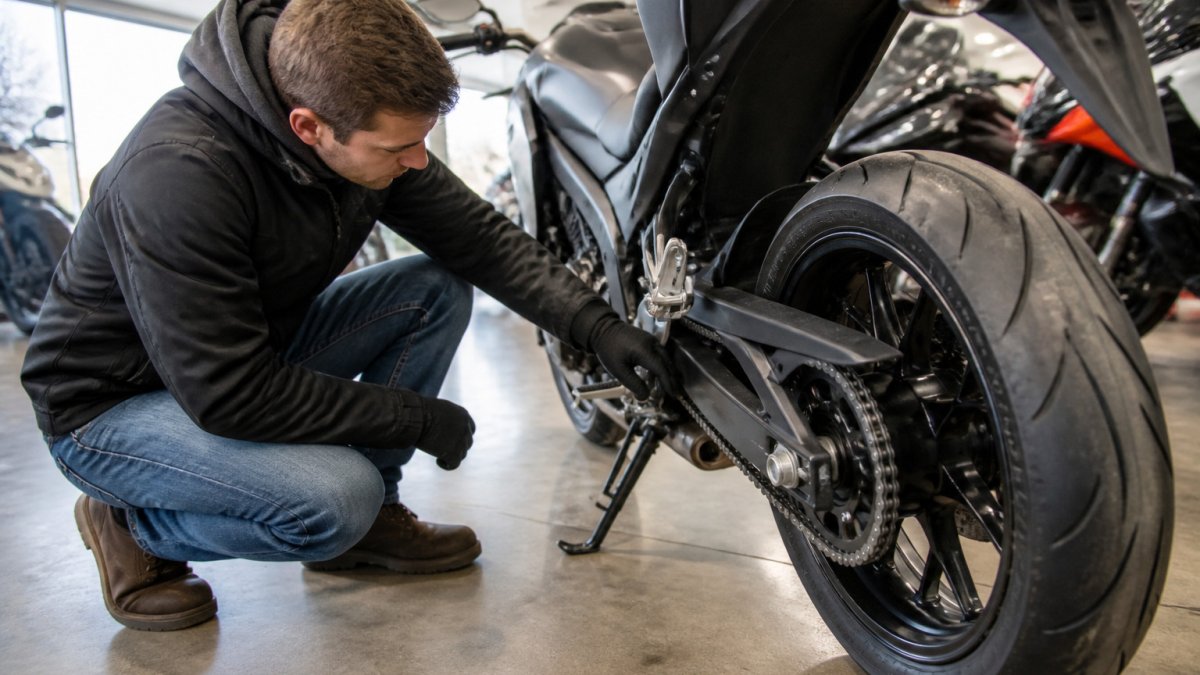
Before you touch the bike: paperwork and cold-start
- VIN match: Find the VIN stamped on the steering head and compare it to the title and registration. A mismatch is a walk-away, not a negotiating point.
- Title status: The title should be in the seller's name with no lienholder. If a lender holds the title, the payoff must be handled at the sale, not promised later.
- Cold start: Ask the seller not to start the bike before you arrive. Listen for slow cranking, clicking, or long crank times. A bike that needs starting fluid or a jump is a project, not a first motorcycle.
Tires, wheels, and brakes
- Tires: Check the date code on the sidewall (last four digits are week and year). Tires older than about five years should be replaced regardless of tread, because rubber hardens and loses grip. Look for sidewall cracks, cupping, and uneven wear suggesting a bent rim or bad alignment.
- Wheels: Spin each wheel and watch the rim at the brake caliper. A wobble or hop means a bent rim or bad bearing. Grab the wheel top and bottom and try to rock it; any play is a bearing problem.
- Brakes: Check pad thickness through the caliper window. If the wear indicator groove is gone, budget for pads. Squeeze the front lever and press the rear pedal; the lever should feel firm, not spongy. Spongy usually means air in the lines or old fluid. Look for deep scoring on the rotor.
Chain, sprockets, and drivetrain
- Chain slack: Check slack at the midpoint of the lower run against the owner's manual spec (commonly around 1 to 1.5 inches on many street bikes, but verify for the model). Too tight wears bearings; too loose can jump the sprocket.
- Chain condition: Look for rust, kinks that do not straighten, and missing O-rings. Pull the chain away from the rear sprocket at the 3 o'clock position; daylight between chain and teeth means the chain is stretched.
- Sprockets: Worn teeth hook or sharpen to a point. A hooked front sprocket is a cheap part but a sign of deferred maintenance.
Frame, forks, and leaks
- Frame: Look for cracks at weld joints, especially near the steering head and swingarm pivot. Fresh paint on one small area can hide a repair.
- Forks: Check fork tubes for pitting and seals for weeping oil. A ring of oil on the tube means a seal replacement; pitting will tear new seals.
- Leaks: Look under the engine, behind the front sprocket cover, and at the bottom of the fork legs. A drop at the drain plug is a crush-washer fix; oil running down the engine case is not.
Electrical and controls
- Lights and switches: Test every switch, including the kill switch, turn signals, brake light (front and rear), and horn. A dead brake light is a safety failure, not cosmetic.
- Battery: Check the date. A battery older than about four years is on borrowed time, and a bike that needs a tender to start is telling you something.
- Gauges and warning lights: Confirm the neutral light, oil-pressure light, and any ABS or check-engine lights behave as the manual describes. A check-engine light that stays on is a diagnostic scan you should price before you buy.
Service records and the test-ride decision
Ask for receipts, not a verbal history. A stack of oil-change receipts and a valve-clearance record is worth more than a clean-looking engine.
If the seller will not let you start the bike cold, will not let a mechanic inspect it, or will not show the title in their name, stop. Those three refusals are the most common pattern in problem sales, and no price is low enough to make them safe.
A pre-purchase inspection by an independent mechanic is a worthwhile step before you buy. Ask the shop to check compression, valve clearance, and any stored diagnostic codes, and get the findings in writing before you negotiate.
If a test ride is not possible because of licensing, insurance, or the seller's preference, a mechanic's inspection plus a cold-start demonstration is a reasonable substitute.
The inspection checklist covers several areas to check before paying, summarised below.
| Area | What to check | Red flag |
|---|---|---|
| Paperwork | VIN matches title and registration | Any mismatch |
| Cold start | Listen for slow cranking or clicking | Needs starting fluid or a jump |
| Tires | Date code; replace if older than about five years | Sidewall cracks or cupping |
| Brakes | Pad thickness; lever feels firm | Spongy lever or deep rotor scoring |
| Chain | Slack against the owner's manual spec | Rust, kinks, or stretched chain |
| Lights and switches | Test every switch, including brake lights | Dead brake light |
| Battery | Check its date | Older than about four years |
Budgeting for Motorcycle Ownership Costs
The purchase price is the smallest number in the first year for many new riders. Build a total-cost-of-ownership estimate before you shop so you can compare a used bike against a new one on equal terms. Use the categories below as a worksheet, and get real quotes rather than guessing.
One-time costs at purchase
- Purchase price and sales tax: Most states collect sales tax at registration, and the rate depends on your county. A private-party sale may still require you to pay use tax when you title the bike.
- Title, registration, and plates: Fees vary by state and by engine size. Check your state motor vehicle agency's fee schedule before you make an offer, because these costs land in the same week as the purchase.
- Insurance: Get quotes before you buy, not after. A fully faired sportbike can cost several times more to insure than a standard or dual-sport bike of the same engine size, especially for a new rider with no riding record. Ask for quotes with and without a completed safety course; many insurers discount for it.
Ongoing costs to plan for
- Fuel: Motorcycles are economical, but smaller tanks mean more frequent stops. Estimate your weekly commute miles and divide by the bike's realistic mpg.
- Maintenance: Oil and filter changes, chain adjustment and lubrication, tire replacement, brake pads, and valve-clearance checks on the manufacturer's schedule. Tires are the big recurring item; sport tires can wear out in a few thousand miles.
- Repairs: Set aside a reserve for the first year. A used bike with unknown history should carry a larger reserve than a new bike under warranty.
A simple worksheet
Add the one-time costs (price, tax, title and registration, insurance for the year, gear, course) to get your first-year cash outlay. Then add the ongoing costs (fuel, maintenance, repairs reserve, storage) to get your annual running cost. Compare two candidate bikes on both numbers, not just the sticker price.
A first motorcycle is affordable when the first-year cash outlay fits your budget without financing the gear and the course. If you need a loan to cover the bike, price the insurance and the first service before you sign, because those costs arrive whether or not the loan payment does.
Be cautious with financing that stretches the term to lower the monthly payment, since a longer term can leave you owing more than the bike is worth. Compare the total of payments, not just the monthly figure.
For current pricing on specific models and financing options, contact Flemington Powersports directly or visit FlemingtonPowersports.com for a quote.
Your Next Step: Book a Test Ride and Gear Up
The best way to confirm a bike fits you is to ride it. Ask the dealer for a test ride on a quiet street or in a parking area first, and make sure you have a valid motorcycle endorsement before you ride.
When you are ready to look at bikes, book a test ride or view our current inventory at Flemington Powersports.
Frequently Asked Questions
What should I check before buying my first motorcycle?
Confirm you hold the correct motorcycle endorsement or permit for your state, sit on the bike to check that you can reach the ground with both feet flat or near flat, and verify the title, VIN and service records. Ask for a test ride on a safe, low-traffic route and have a mechanic inspect the bike if it is used. Get an insurance quote before you pay, because premiums vary widely by model, age and riding history.
Should I buy a new or used motorcycle as my first bike?
A used motorcycle is often the more practical first bike because a beginner is likely to drop it or scratch it while learning, and a lower purchase price limits the financial hit. A new bike comes with a full warranty and a known service history, which can matter if you want fewer surprises. Either way, choose a smaller, lighter model with manageable power and a seat height you can handle.
What safety gear should I buy with my first motorcycle?
Buy a DOT-approved helmet, a riding jacket with armor, gloves, riding pants or armored jeans, and over-the-ankle boots before your first ride. Look for a helmet that fits snugly with no pressure points and replace it after any crash. Gear is a fixed cost to budget alongside insurance, registration and maintenance.
How do I know if a motorcycle is beginner-friendly?
A beginner-friendly motorcycle has a moderate engine size, a low seat height you can comfortably reach, a manageable weight you can hold upright and walk, and predictable handling with smooth throttle response. Ask the seller or manufacturer for the seat height and wet weight, then compare those figures with your own height and strength before deciding.
Get started with Flemington Powersports to find a beginner-friendly bike, check its condition, and ride with confidence.